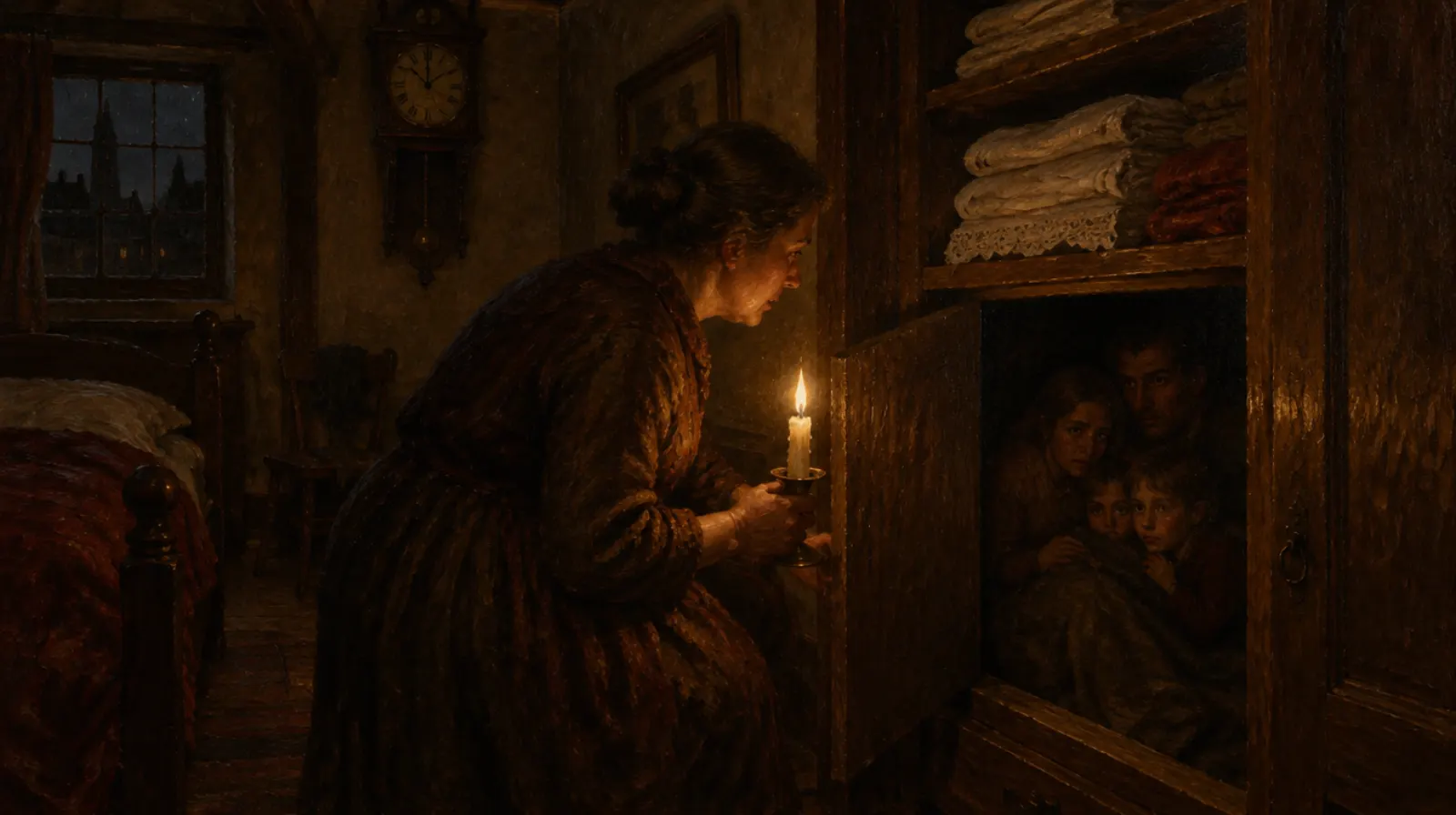
During World War II, the Nazi government that ruled Germany took over the Netherlands, a small country in Europe. They began arresting Jewish people and sending them away to camps. Many were never seen again.
In the city of Haarlem, above a small watch shop, one Christian family decided to open their door.
The watchmakers
Corrie ten Boom was born in 1892. She lived with her father, Casper, and her older sister, Betsie, above the family watch shop. Corrie was the first woman in the Netherlands licensed as a watchmaker. The family prayed together every day and were known for taking in anyone who needed help.
When Jewish neighbors began to disappear, the ten Booms started hiding people in their home. Builders made a secret room behind a false wall in Corrie's bedroom, at the top of the house. It was so narrow that only a few people could stand in it. When a buzzer sounded, the people hiding would rush up the stairs and slip inside.
Over the next two years, the family and the people working with them helped hide and move many Jewish people and members of the Dutch resistance. It is often estimated they helped save about 800 lives.
The arrest
On February 28, 1944, someone betrayed them. Police raided the house and arrested the family. But they never found the secret room. The six people hiding inside it stayed silent for almost two days and later escaped.
Corrie's father, Casper, was eighty-four. He died about ten days after the arrest. Corrie and Betsie were sent to Ravensbrück, a women's prison camp in Germany. Betsie, weak and sick, died there in December 1944. Days later, Corrie was released because of a paperwork mistake.
Forgiveness
After the war, Corrie traveled the world telling people about God's love. In 1947, after speaking at a church in Germany, a man came up to her. She recognized him as one of the guards from Ravensbrück. He told her he had become a Christian and asked for her forgiveness.
She wrote later that she could not feel forgiveness on her own. She prayed, and then she took his hand.
In 1967, Yad Vashem, Israel's memorial to the victims of the Holocaust, honored her as one of the Righteous Among the Nations.
Why she did it
Jesus said that welcoming a stranger was welcoming him.
For I was an hungred, and ye gave me meat: I was thirsty, and ye gave me drink: I was a stranger, and ye took me in:
Matthew 25:35 · King James VersionThe original Greek
ἐπείνασα γὰρ καὶ ἐδώκατέ μοι φαγεῖν, ἐδίψησα καὶ ἐποτίσατέ με, ξένος ἤμην καὶ συνηγάγετέ με,
Found in Codex Vaticanus (about AD 325), Codex Sinaiticus (about AD 350).
The ten Booms took in strangers, at the cost of their own lives.
What it means for us
Many Christians in those years did nothing, out of fear. We should be honest about that. The ten Booms were not braver because they were special. They were ordinary people who decided that the person at their door mattered more than their own safety.
Most of us will never face that choice. But you will meet people who need someone to open a door. And if you are carrying something you cannot forgive, Corrie would tell you that she could not do it alone either.