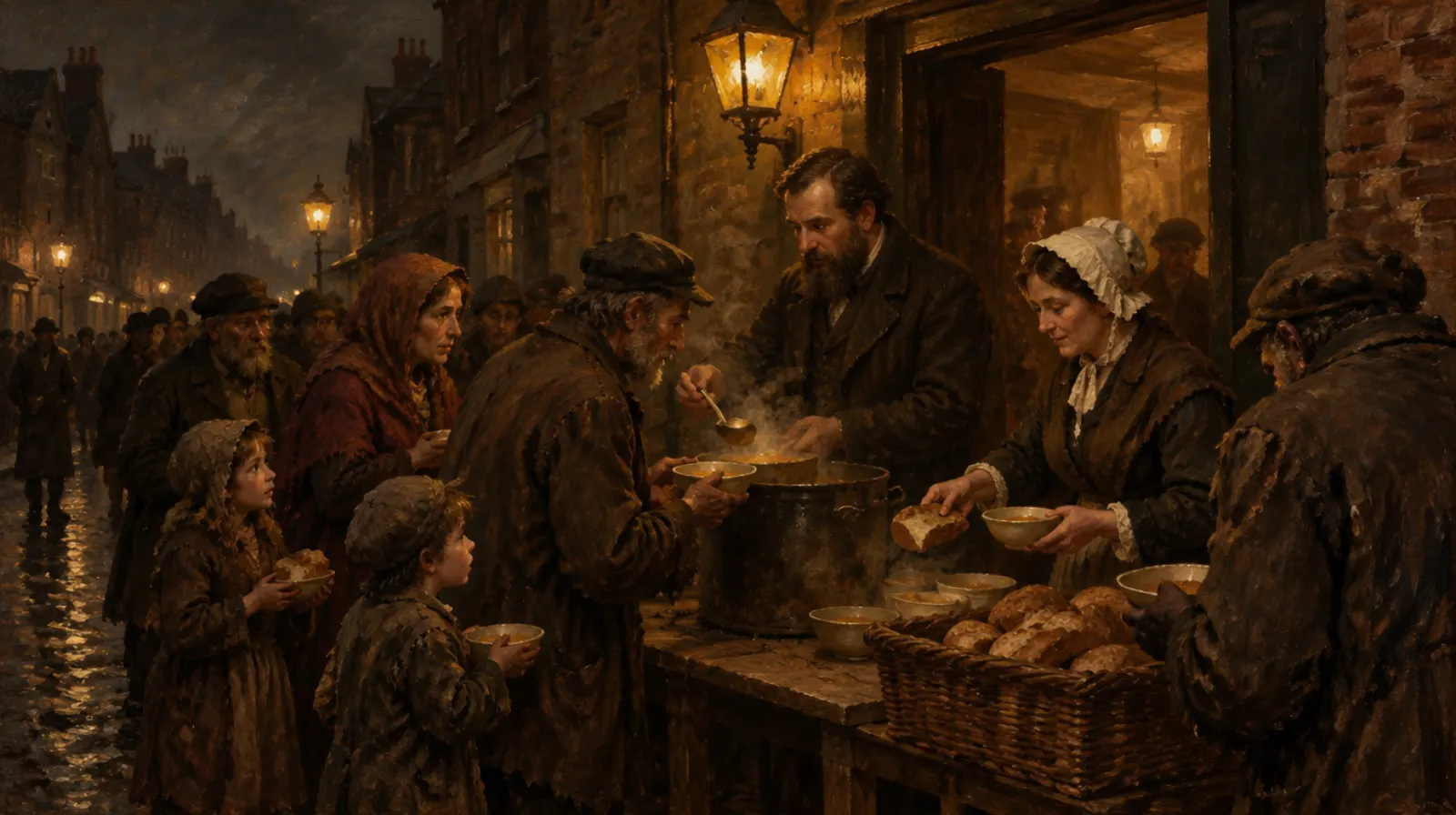
In the 1860s, the East End of London was one of the poorest places in the world. Families crowded into single rooms. Children went hungry. Many men and women drank to forget how hard life was. Most churches did not reach them, and some poor people felt they were not welcome inside.
A preacher and his wife went to them instead.
A tent in the East End
William Booth was a Methodist preacher, a minister in a Christian church that started in England in the 1700s. His wife, Catherine, was a strong preacher too, at a time when very few women were allowed to preach.
In 1865, William began preaching in a tent in Whitechapel, a poor neighborhood in the East End. He spoke to people churches often ignored: drunks, thieves, homeless people and the very poor. Many of them became Christians. But he and Catherine soon saw that you cannot preach to a hungry person and walk away.
Soup, soap and salvation
The Booths and their helpers began giving food to the hungry. They opened places where poor people could get a hot meal cheaply, and shelters where homeless men could sleep. They helped people with drinking problems get sober. Catherine worked especially for poor women and girls.
At first the group was called the Christian Mission. In 1878 they renamed it the Salvation Army, and gave it uniforms and ranks, like an army that fought poverty and despair instead of people.
Opposition
Not everyone liked them. Pub owners lost customers when drinkers got sober. Gangs, some called the Skeleton Army, attacked their marches, threw stones and beat members. Some church leaders thought their loud street music and women preachers were improper. They kept going.
In 1890, William wrote a book called In Darkest England and the Way Out, with a plan for jobs, shelters and training for the poor. Catherine died that same year. William died in 1912. By then the Salvation Army was working in many countries. Today it serves in more than 130.
Why they did it
Jesus said that feeding the hungry was feeding him.
For I was an hungred, and ye gave me meat: I was thirsty, and ye gave me drink: I was a stranger, and ye took me in:
Matthew 25:35 · King James VersionThe original Greek
ἐπείνασα γὰρ καὶ ἐδώκατέ μοι φαγεῖν, ἐδίψησα καὶ ἐποτίσατέ με, ξένος ἤμην καὶ συνηγάγετέ με,
Found in Codex Vaticanus (about AD 325), Codex Sinaiticus (about AD 350).
What it means for us
The Booths went to people many churches had stopped noticing. We Christians are still sometimes better at waiting for people to come in than at going out. That is honest.
You do not need a uniform to do what they did. A sandwich for someone hungry, a ride to a recovery meeting, or a welcome to someone who feels out of place at church is the same work.