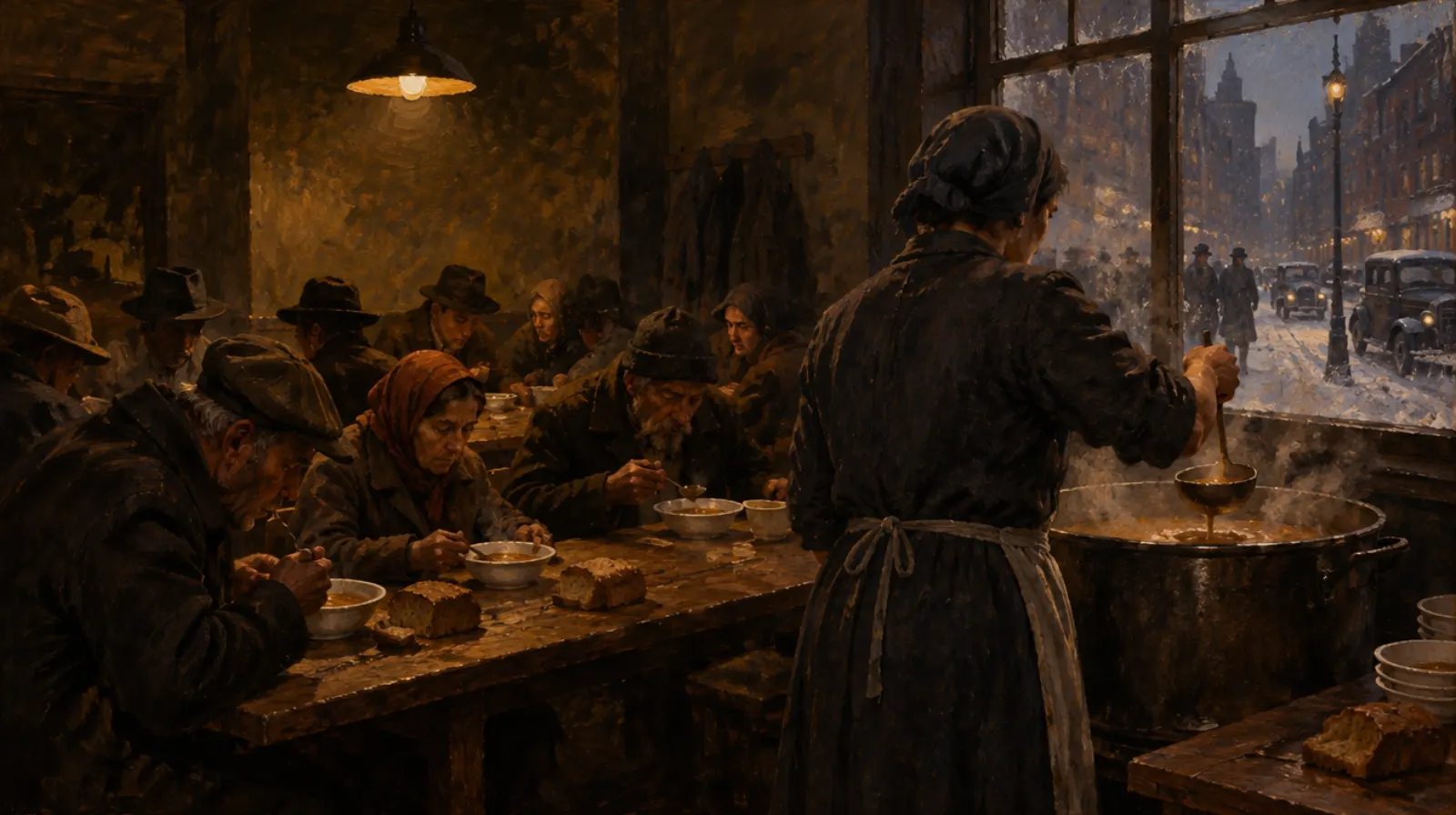
In the early 1930s, the United States fell into the Great Depression. Banks failed. Millions of people lost their jobs. Lines of hungry men stretched down city blocks, waiting for a bowl of soup. Families lost their homes.
In New York City, one woman decided the hungry could not wait for someone else to fix it.
A writer with questions
Dorothy Day was born in 1897. She grew up to be a newspaper writer in New York, working for papers that cared about poor workers. For years she did not go to church. She had lived a hard and complicated life, and she had made choices she later regretted.
Then, after the birth of her daughter, she found herself wanting to thank someone. In 1927 she became a Catholic. But she still wanted to know how faith and the hungry people outside her window fit together.
The Catholic Worker
In 1932 she met Peter Maurin, a French immigrant who had worked as a laborer and wandered the country thinking about how Christians should live. He told her Christians should open their own homes to the poor, the way the early church did.
On May 1, 1933, they began selling a newspaper called The Catholic Worker for one cent a copy. Soon after, people started showing up at their door, hungry. So they fed them.
They rented an apartment, then a house, and called it a house of hospitality. Anyone who was hungry could come in and eat. People who had felt ashamed and alone in the soup lines found a place where they were welcome. Anyone with nowhere to sleep could find a bed. Nobody had to prove they deserved it. During the worst years of the Depression, their kitchen served hundreds of people every day.
She lived with them
Dorothy did not run the houses from far away. She lived in them, in a small room, sharing the food and the noise and the bedbugs with the people she served. She wrote and spoke about the poor for the rest of her life. She died in 1980, in one of those houses, among the people she had chosen.
Today there are more than a hundred Catholic Worker communities. The Catholic Church has opened the process that could one day name her a saint.
Why she did it
She took Jesus's story about the king and the two groups at its word. The king says, "I was an hungred, and ye gave me meat." Matthew records the whole list.
For I was an hungred, and ye gave me meat: I was thirsty, and ye gave me drink: I was a stranger, and ye took me in:
Matthew 25:35 · King James VersionThe original Greek
ἐπείνασα γὰρ καὶ ἐδώκατέ μοι φαγεῖν, ἐδίψησα καὶ ἐποτίσατέ με, ξένος ἤμην καὶ συνηγάγετέ με,
Found in Codex Vaticanus (about AD 325), Codex Sinaiticus (about AD 350).
For Dorothy, the man in the soup line was the person Jesus meant.
What it means for us
Most of us would not choose to live the way she did. That is honest. But she showed what it looks like when someone takes "I was hungry" personally. If you have ever handed someone a meal, you have done a small piece of what she did. You can do it again this week.