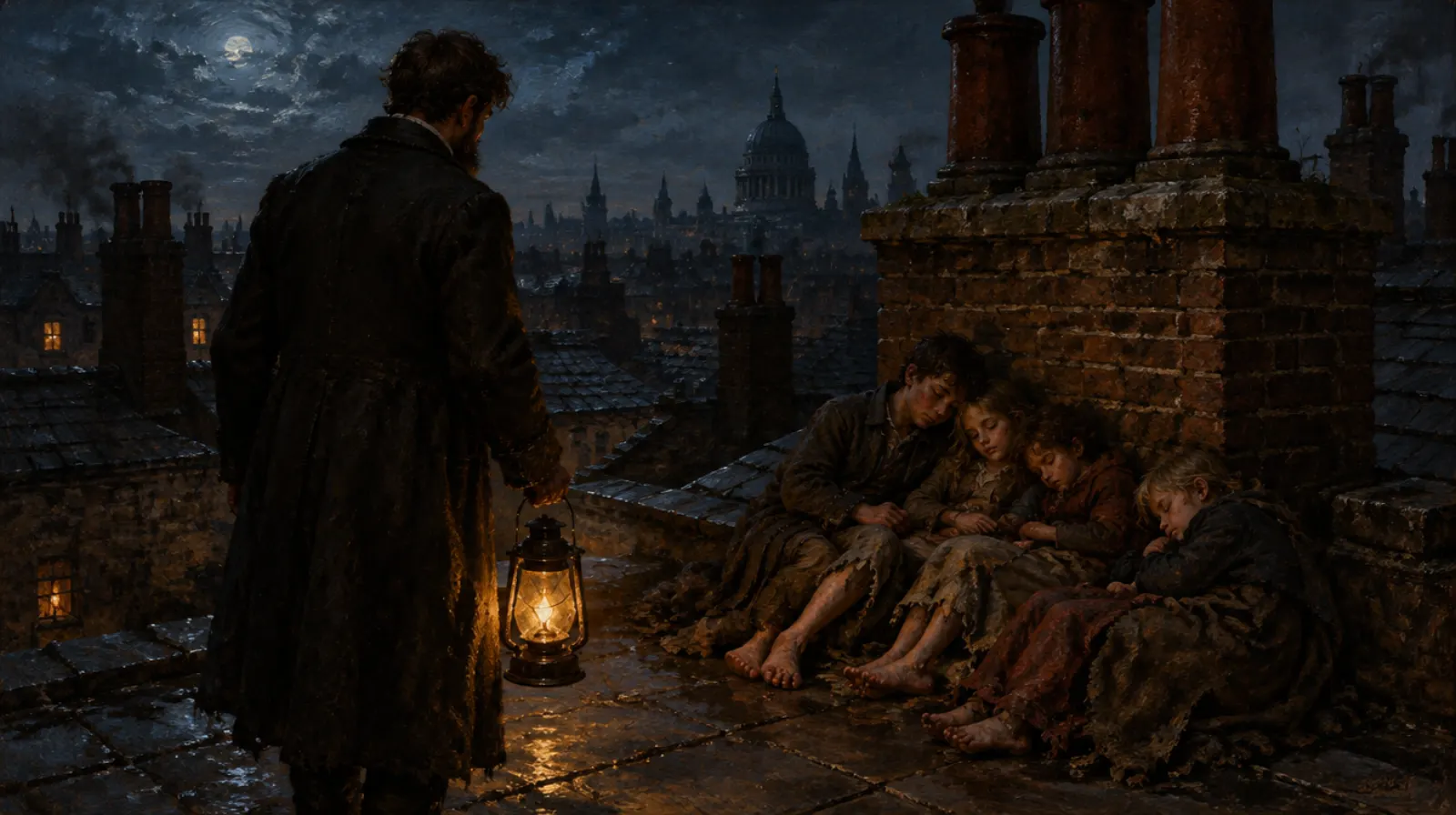
In the 1860s, London was the richest city in the world. It was also full of children with nowhere to live. They sold matches, swept streets, begged and slept wherever they could. Many died young of cold, hunger and sickness.
A young man who came to London to become a missionary found his mission on its streets.
The boy who showed him
Thomas Barnardo was born in Dublin, in Ireland, in 1845. As a young man he became a committed Christian and moved to London in 1866 to train as a doctor. He planned to go to China as a missionary.
In London's poor East End, he started a free school for children in the evenings, a "ragged school," named for the ragged clothes the children wore. One night, after the lesson, a boy named Jim Jarvis did not want to leave. Barnardo told him to go home. Jim said he did not have a home.
Barnardo did not believe him at first. So Jim took him out into the night and showed him. On a rooftop, Barnardo later wrote, he found a group of boys asleep in the open, in the cold, with no blankets and no one to care for them.
He never went to China.
No child refused
In 1870, Barnardo opened a home for boys on a street called Stepney Causeway. At first, it had a limit on how many boys it could take.
Then one night, a boy known as "Carrots," whose real name was John Somers, was turned away because the home was full. A few days later, he was found dead from cold and hunger.
Barnardo was devastated. He put up a sign over the door: "No destitute child ever refused admission." From then on, his homes never turned a child away.
His work grew and grew. He opened homes for girls, too, and trained children in trades so they could support themselves. By the time he died in 1905, his homes had cared for around 60,000 children. The charity that carries his name still helps children in Britain today.
Why he did it
Jesus said that welcoming a child was welcoming him.
And whoso shall receive one such little child in my name receiveth me.
Matthew 18:5 · King James VersionThe original Greek
καὶ ὃς ἐὰν δέξηται ἓν παιδίον τοιοῦτο ἐπὶ τῷ ὀνόματί μου, ἐμὲ δέχεται.
Found in Codex Vaticanus (about AD 325), Codex Sinaiticus (about AD 350).
What it means for us
Barnardo's story has hard parts too. His charity later sent thousands of children overseas to Canada and Australia, and many suffered there. The charity has since said that was wrong. We can admire what he got right and be honest about what went wrong.
What he got right was simple: he did not turn a child away. If you know a child who needs someone, you do not need to open a home. Being one steady, safe adult in their life is the same welcome.