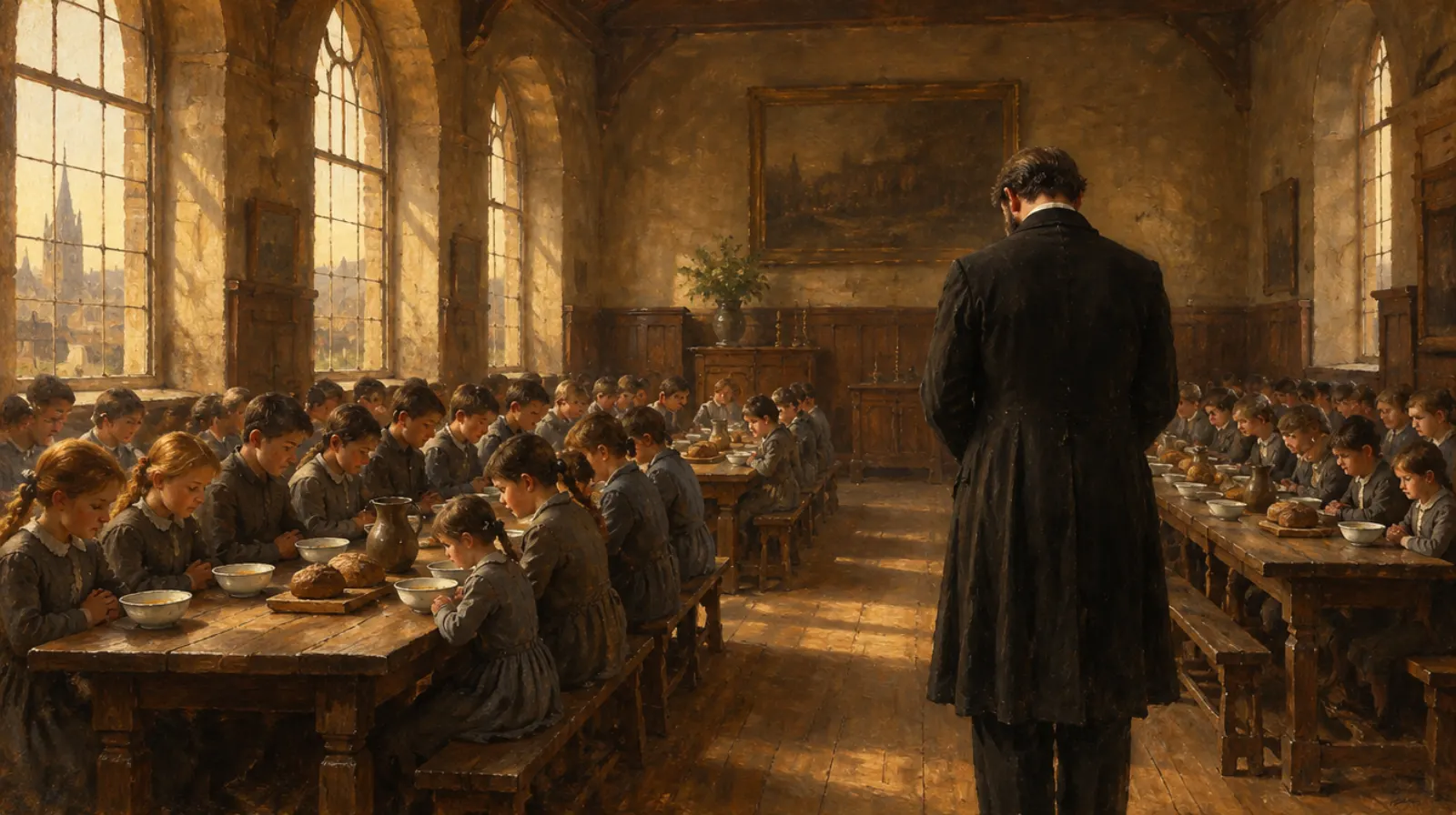
In the 1800s, England's cities were full of orphans. Disease killed many parents young. Children with no family ended up in workhouses, places where poor people were made to work in hard conditions for food, or on the streets. Many did not live long. Children who were alone and afraid had almost nowhere to go.
In the city of Bristol, a young pastor started taking them in.
A wild young man
George Müller was born in 1805 in Prussia, part of what is now Germany. As a teenager, he lied, gambled, drank and stole. He was even put in jail for a short time for not paying his bills.
At twenty, a friend took him to a small Bible study in a home. Something in the simple prayer there changed him. He became a Christian, moved to England, and in 1832 became a pastor in Bristol.
The first home
Müller saw children in the streets of Bristol with no one to care for them. In 1836 he and his wife, Mary, rented a house on Wilson Street and opened it as a home for orphan girls. Soon they opened another, then another.
He made one unusual decision. He would never ask anyone for money. He would tell God what the children needed, in prayer, and trust that people would give. He kept careful records of every gift that came in, large or small.
The homes kept growing. In 1849 he opened the first of five large buildings on Ashley Down, a hill outside the city. By the time the fifth opened, they could care for about two thousand children at a time.
More than food
Müller did not only feed the children. He made sure they were taught to read and write, which many people at the time thought was a waste on poor children. When they grew up, he helped them find jobs or training.
Over his lifetime, more than ten thousand children lived in his homes. He died in 1898, at ninety-two. The charity he started still works with children and families in Bristol today.
Why he did it
Jesus once scolded his own friends for sending children away.
But when Jesus saw it, he was much displeased, and said unto them, Suffer the little children to come unto me, and forbid them not: for of such is the kingdom of God.
Mark 10:14 · King James VersionThe original Greek
ἰδὼν δὲ ὁ Ἰησοῦς ἠγανάκτησεν καὶ εἶπεν αὐτοῖς· Ἄφετε τὰ παιδία ἔρχεσθαι πρός με, μὴ κωλύετε αὐτά, τῶν γὰρ τοιούτων ἐστὶν ἡ βασιλεία τοῦ θεοῦ.
Found in Codex Vaticanus (about AD 325), Codex Sinaiticus (about AD 350).
"Suffer" in old English means "let." Müller let them come.
What it means for us
We Christians have not always cared for children well. Some church homes in history treated children harshly, and we should not hide that. But Müller showed what it looks like to treat a forgotten child as someone Jesus wants near him.
You may never run an orphanage. But you might mentor a child, support a foster family, or give to a group that cares for kids with no one. If you do, you are doing the same work, just one child at a time, and that child will know they are loved.