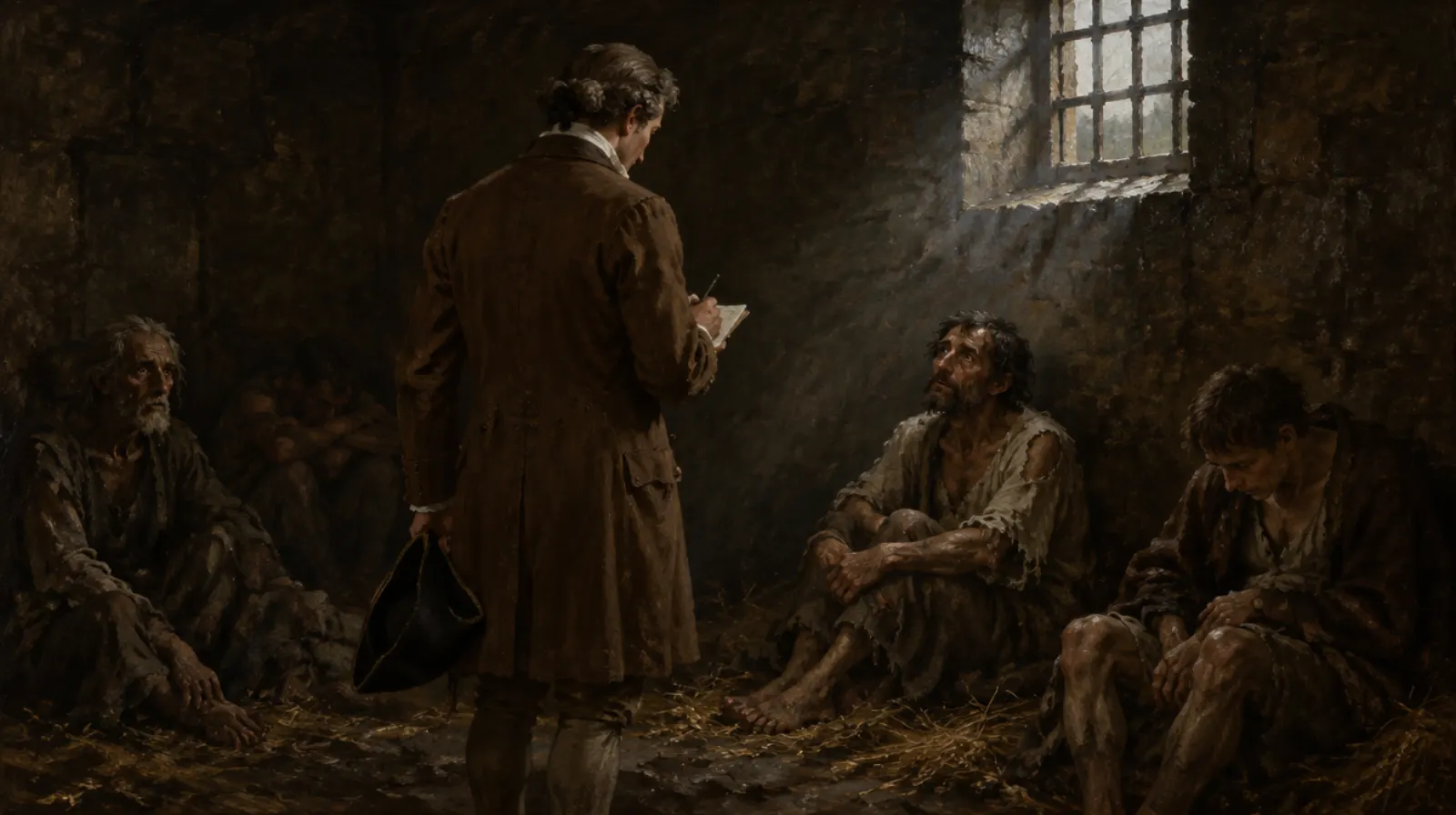
Two hundred and fifty years ago, English jails were dark, filthy and deadly. Jailers were not paid by the government. They made their money by charging the prisoners fees. A person could be found innocent in court and still stay locked up, because they could not pay the jailer to let them out.
Most people never went inside to see. One man did.
The sheriff who went in
John Howard was born around 1726 into a well-off English family. He was a devout Christian from a church outside the Church of England. He had known hardship himself. As a young man, he had been captured at sea by French privateers, armed ships that seized enemy vessels, and held for a time as a prisoner of war.
In 1773 he was made High Sheriff of Bedfordshire, a county north of London. The job came with responsibility for the county jail. Most sheriffs never looked. John went to see it.
What he found broke his heart. Prisoners slept on damp floors. Many were sick with "jail fever," a deadly disease that spread in crowded cells. Some had been there for months after a court had already set them free, because they owed the jailer money.
He kept going
He asked the government to pay jailers a salary so prisoners would not be held for fees. To make his case, he went to see other jails. Then more. He traveled thousands of miles on horseback, across England and then across Europe, writing down what he saw: the size of the cells, the food, the water, the number who died.
In 1774, Parliament passed laws to end the fees for prisoners found innocent and to keep jails cleaner. In 1777 he published The State of the Prisons, a careful, plain record of everything he had found.
He kept visiting prisons and hospitals for the rest of his life. In 1790, while inspecting prisons and military hospitals in Kherson, in what is now Ukraine, he caught a fever and died. He was about sixty-four.
Today a charity that works for better prisons in Britain, the Howard League, still carries his name.
Why he did it
He believed Jesus meant what he said about the people in prison.
Naked, and ye clothed me: I was sick, and ye visited me: I was in prison, and ye came unto me.
Matthew 25:36 · King James VersionThe original Greek
γυμνὸς καὶ περιεβάλετέ με, ἠσθένησα καὶ ἐπεσκέψασθέ με, ἐν φυλακῇ ἤμην καὶ ἤλθατε πρός με.
Found in Codex Vaticanus (about AD 325), Codex Sinaiticus (about AD 350).
What it means for us
Most of us rarely consider what goes on inside prisons. That is honest. John Howard was not a famous preacher. He was a man with a job who decided to go and look, and then to write down what he saw.
You can do something like that too. Learn what prisons near you are like. Write to someone inside. Support a group that helps prisoners and their families. Looking, instead of looking away, is where it starts. The people inside are still loved by God, and they still need someone to care.