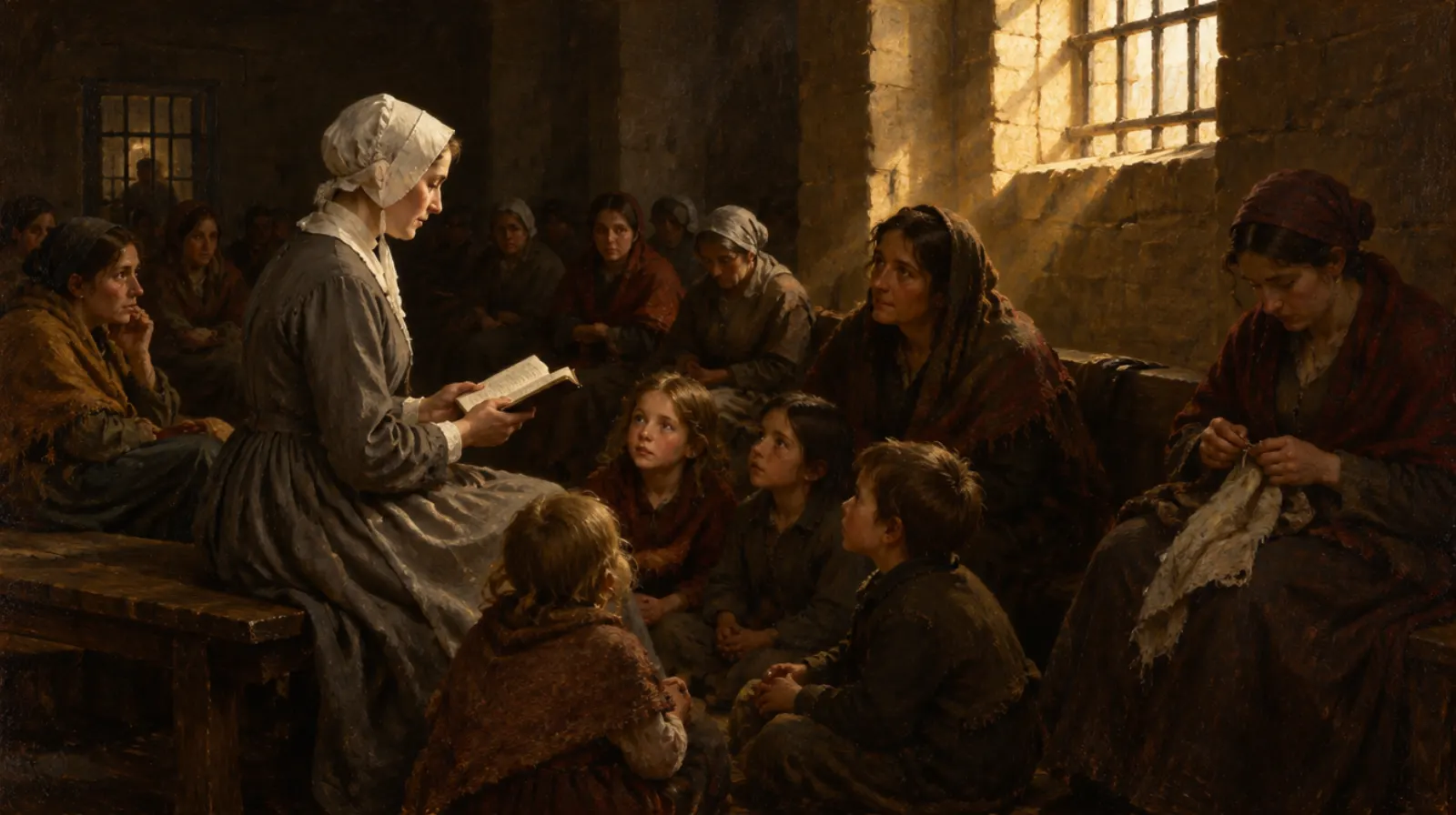
Two hundred years ago, prisons in England were terrible places. Women and children were crowded together in dark rooms, often with little food or clothing. Some children were born there. Most people never thought about them.
One woman did.
A Quaker mother
Elizabeth Fry was born in England in 1780. She belonged to the Quakers, a Christian group that believed every person carries something of God and should be treated with dignity. She married, and she had eleven children.
In 1813, a friend told her about the women in Newgate, a prison in London, the capital city of England. She went to see for herself.
She found about three hundred women and their children packed into a few rooms. They slept on the floor and cooked and washed in the same place where they lived. Some were waiting for trial. Some were waiting to be sent across the world to Australia, then a British colony, as punishment.
What she did
Elizabeth brought clothes for the children. A few years later, around 1816, she came back and began visiting regularly. She started a school inside the prison for the children, and taught the women to sew so they could earn a little money. She read the Bible to them, and she treated them as people worth teaching.
In 1817 she and other women formed a group to keep helping the women prisoners. Later she visited the ships that carried women to Australia and pushed for better conditions on board. She traveled to other countries to speak about prisons, and she spoke to leaders in England's Parliament.
Why she did it
She took Jesus at his word. In his story about the king and the two groups, the king thanks the people who visited him in prison. Matthew records it.
Naked, and ye clothed me: I was sick, and ye visited me: I was in prison, and ye came unto me.
Matthew 25:36 · King James VersionThe original Greek
γυμνὸς καὶ περιεβάλετέ με, ἠσθένησα καὶ ἐπεσκέψασθέ με, ἐν φυλακῇ ἤμην καὶ ἤλθατε πρός με.
Found in Codex Vaticanus (about AD 325), Codex Sinaiticus (about AD 350).
For Elizabeth, the women of Newgate were the people Jesus meant.
From 2002 to 2016, her face was printed on the Bank of England's five-pound note.
What it means for us
Most of us have never thought much about people in prison. That is honest. But one woman with a large family and a busy life decided to go and see. If you want to do something like that, you can start small: write a letter, give to a group that serves prisoners' families, or simply stop seeing people in prison as beyond help. Elizabeth Fry did not think anyone was beyond God's love, and you do not have to either.