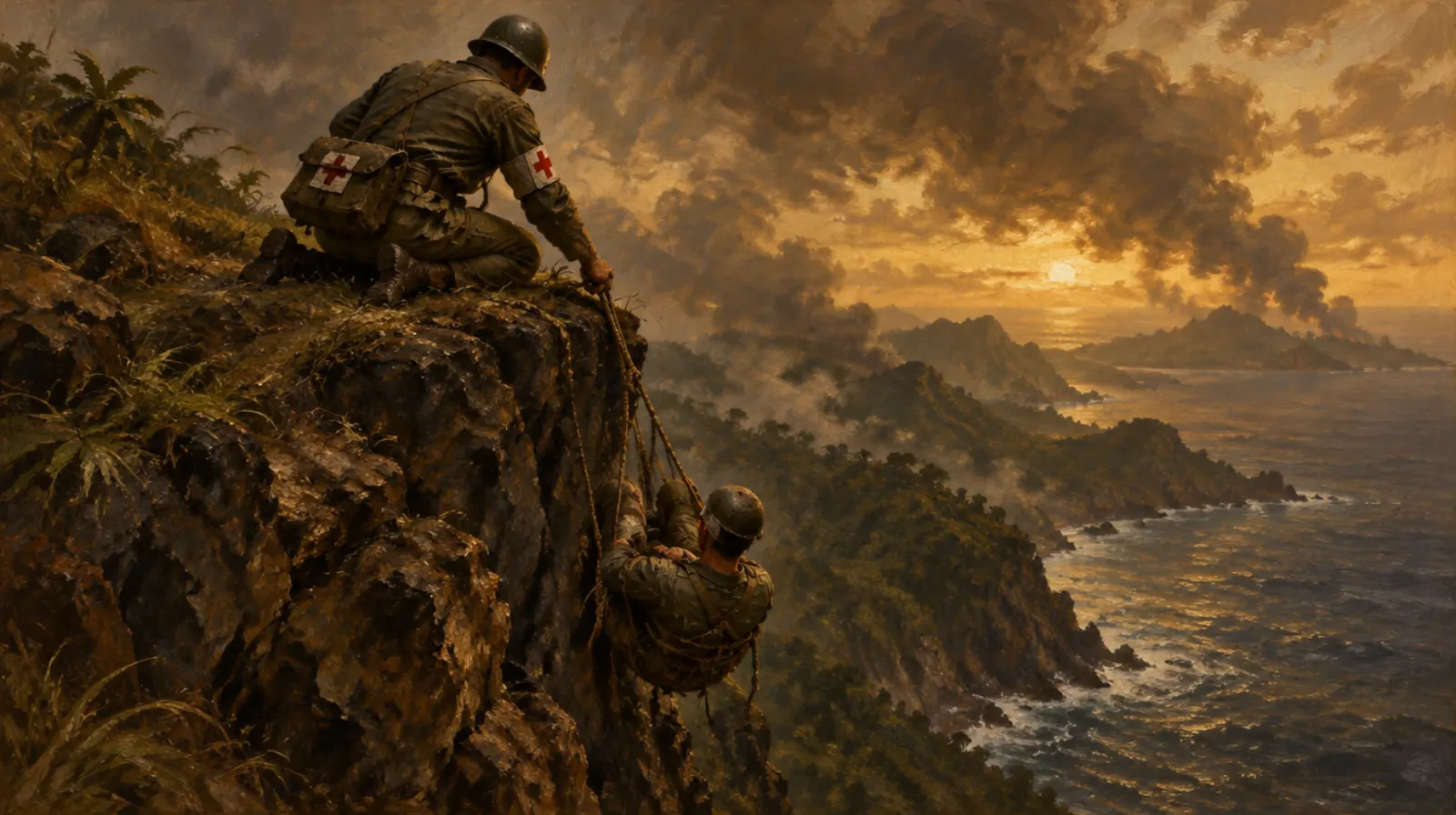
When the United States entered World War II, millions of young men joined the army. Desmond Doss joined too. But he made one promise he would not break: he would not carry a gun.
The soldier without a rifle
Desmond Doss was born in 1919 in Lynchburg, Virginia. He was raised a Seventh-day Adventist, a Christian church that takes the commandment "Thou shalt not kill" very seriously.
He joined the army in 1942 and asked to serve as a medic. He wanted to save lives, not take them. He did not call himself a conscientious objector, someone who refuses to fight for reasons of faith. He called himself a "conscientious cooperator," because he wanted to serve, just without a weapon.
The other soldiers mocked him. Some threw boots at him while he prayed. His officers tried to have him thrown out of the army. He stayed.
The cliff
In the spring of 1945, his unit fought on Okinawa, an island south of Japan. They had to climb a steep cliff, about four hundred feet high, that soldiers called Hacksaw Ridge.
On May 5, 1945, his unit was driven back down the cliff under heavy fire. Many wounded men were left at the top. Doss stayed.
Alone, he crawled to each wounded man, dragged him to the edge, tied him in a rope sling and lowered him down the cliff to safety. Then he went back for another. Over and over. He later said he prayed each time, "Lord, please help me get one more."
The army estimated he saved about 75 men that day.
Medal of Honor
Weeks later, Doss was badly wounded himself. While he waited for help, he gave his stretcher to another wounded man.
On October 12, 1945, President Harry Truman gave him the Medal of Honor, the highest award for bravery in the United States military. He was the first conscientious objector in World War II to receive it. He died in 2006.
Why he did it
Doss lived out the words Jesus said on the night before he died.
Greater love hath no man than this, that a man lay down his life for his friends.
John 15:13 · King James VersionThe original Greek
μείζονα ταύτης ἀγάπην οὐδεὶς ἔχει, ἵνα τις τὴν ψυχὴν αὐτοῦ θῇ ὑπὲρ τῶν φίλων αὐτοῦ.
Found in Codex Vaticanus (about AD 325), Codex Sinaiticus (about AD 350).
He risked his life again and again, for men who had once mocked him.
What it means for us
Doss did not shame the soldiers who carried guns. He simply would not carry one himself, and he chose to save life instead. Many of us have been the one mocking someone for their faith, or the one being mocked. He shows that mercy can keep going even then.
If you have ever been laughed at for doing what you believed was right, you are in good company. One more act of kindness, like one more man down the cliff, still matters.