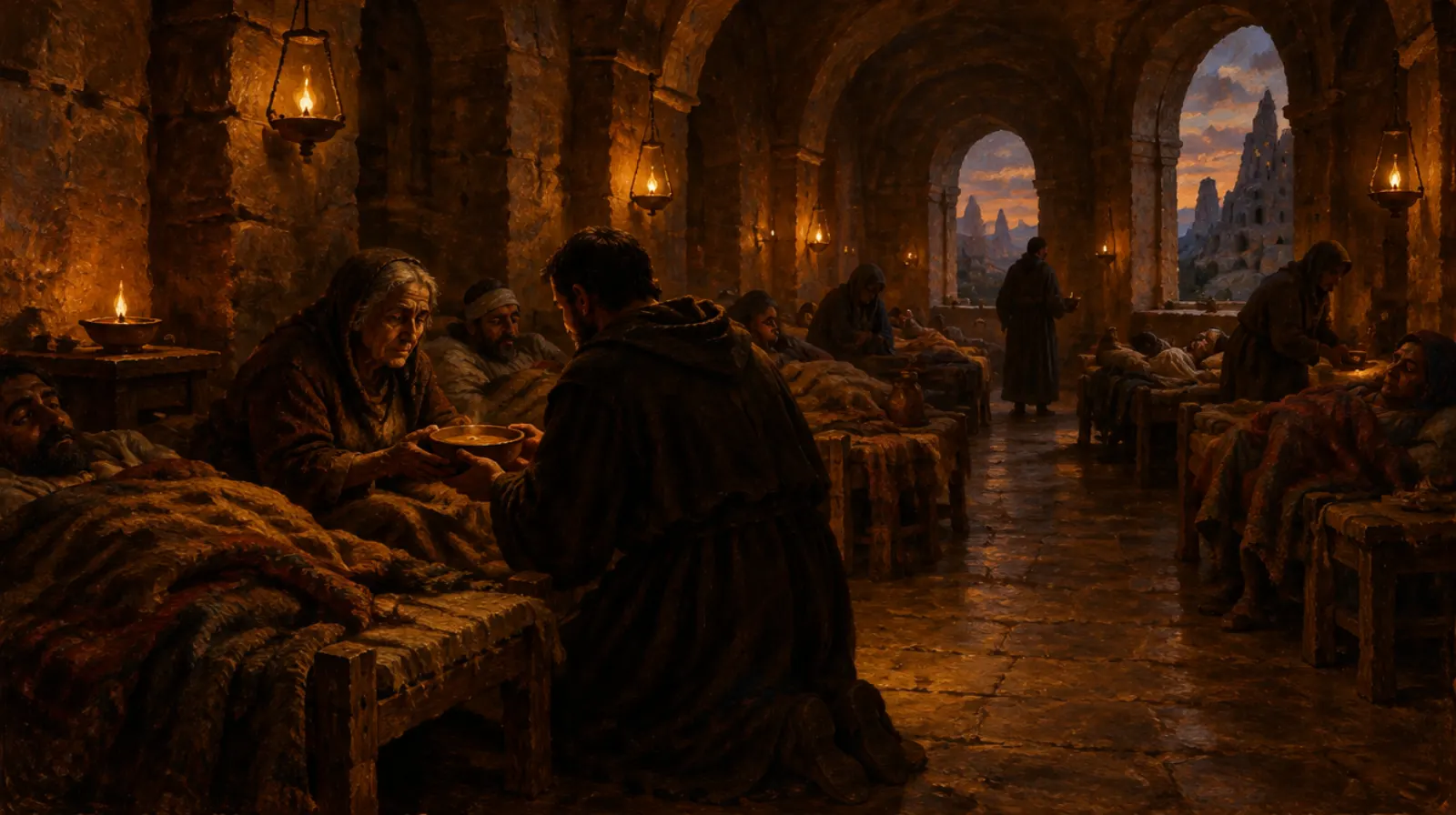
Today we expect a hospital in every city. We forget that for most of history, if you were poor and sick, there was nowhere to go. Some of the first places that took in anyone, for free, were started by Christians trying to do what Jesus said.
The year of hunger
Basil was a bishop, a leader of the churches, in a city called Caesarea, in the land that is now central Turkey. Around the year 368, the rain did not come and the crops failed. People were starving.
Basil came from a rich family. So he sold land he had been given and used the money to buy food. His friend Gregory, another church leader who later wrote about his life, said Basil cooked and served the hungry himself, and did not ask who was a Christian and who was not.
The new city
After the hunger was over, Basil did not stop. Around AD 369, he started building on the edge of the city. It grew into a whole group of buildings: houses for the poor, a place for travelers, rooms for the sick, and care for people with leprosy, a skin disease that made others afraid to touch them.
Doctors and nurses worked there. Gregory wrote that it was so big it was like a new city. People started calling the place the Basiliad, which means Basil's place.
A woman in Rome
A few years later, around AD 390, a rich Roman woman named Fabiola did something similar in Rome. Jerome, a Bible scholar who knew her, wrote that she opened a hospital and carried sick people in from the streets herself. She washed wounds that other people would not look at.
What it means for us
We Christians have not always lived like this. We have also built gold churches while people outside went hungry. But Basil and Fabiola show what it looks like when people take Jesus at his word, that helping the sick is helping him.
You do not need to build a hospital. You can bring soup to a sick neighbor, or sit with someone in a waiting room so they are not alone. That is the same mercy, just smaller, and it still counts.